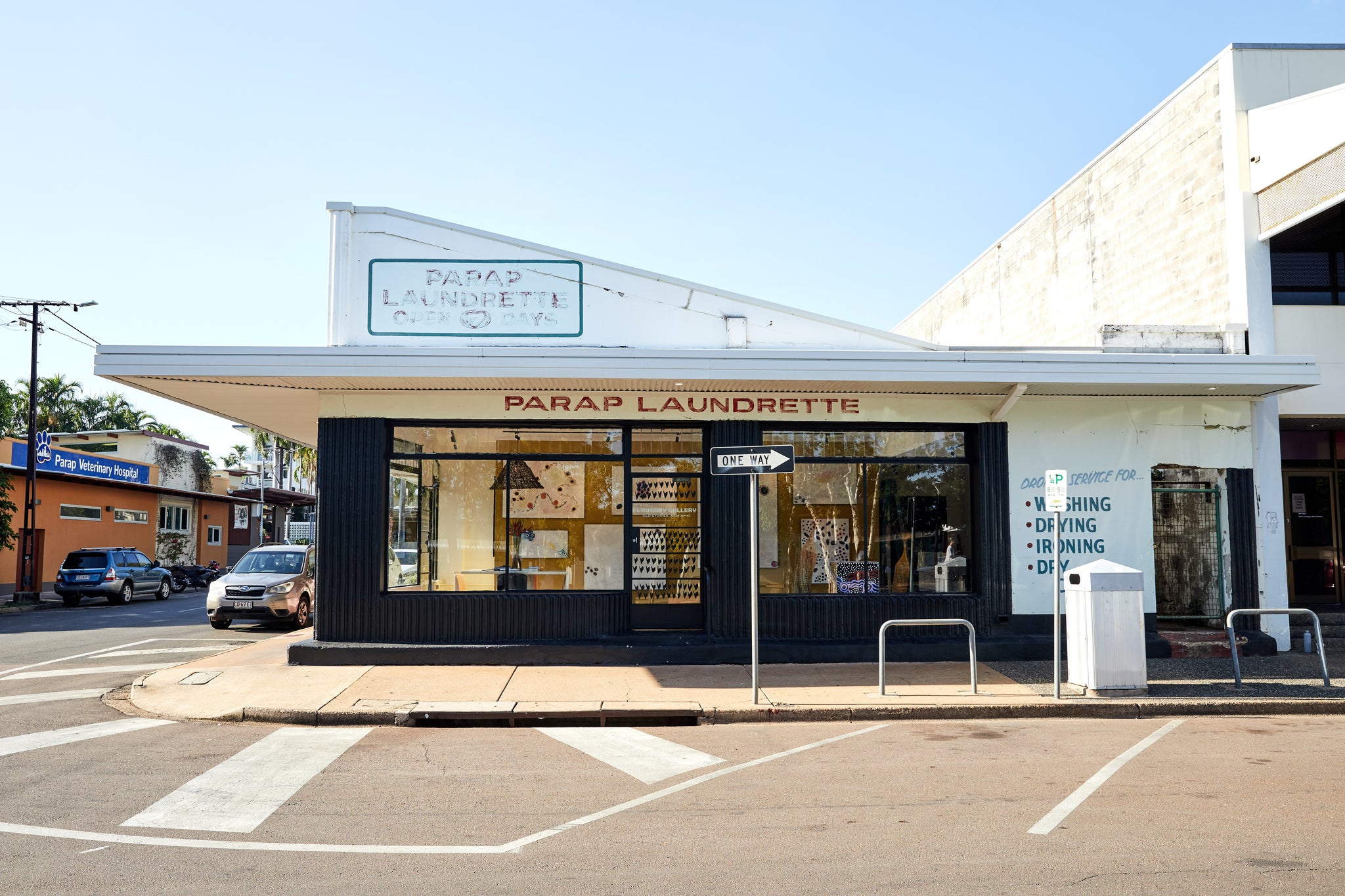
PAST, PRESENT, FUTURE.
OLD STORIES, NEW SPIN.


THE RINSE CYCLE


Times Square
Time Square is a meditation on lost time and the way it slips quietly from view. Each work draws the eye inward, toward a centre where time feels like it’s fading away. The repetitive lines are intentional and grounding—painting them brings a sense of calm, allowing me to lose myself in the rhythm. Through this process, the noise of the outside world dissolves, and what remains is a quiet space where time becomes soft, slow, and suspended.
DETAILS
- Acrylic on Canvas
- Dimensions: 135 x 205 cm
- Cat No. CT-26-403
ARTIST
Clifford belongs to the Kaytetye language group, his mother’s country is Karlu Karlu (Devil’s Marbles) and his father’s country is Jarrah Jarrah. He was brought up in Ali Curang and his interest in art began as a boy at school doing chalk drawings on small blackboards. Clifford went to school with Fabian and Lindsay and they still live close up in the south fringe camp.
Clifford has a strong work ethic and has worked at the Nyinkka Nyunyu precinct in the gardens and in particular with suicide bead project which makes painted beads for young people at risk. He is currently working with the council fencing and paints for the Tennant Men's Brio. Clifford likes to paint to for its meditative process which assists him to steer away from alcohol and keeps his mind off any problems. Painting is also a way for him to connect with country and remember his ancestors. Clifford preferred medium is acrylic on board. Clifford enjoys creating spacial patterns. His bold and rhythmic work depicts various aspects of life in Tennant and country, mainly from his mother’s country.
ART CENTRE
Located in the heart of Tennant Creek in the Northern Territory, Nyinkka Nyunyu Art & Culture Centre is a leading Aboriginal cultural centre, museum and art gallery created by and for the Warumungu people of the Barkly Region. Established through the vision and leadership of Warumungu Traditional Owners, the Centre was created to protect a significant sacred site, preserve cultural knowledge, and share the stories, art and history of Warumungu Country with future generations and visitors alike.
Nyinkka Nyunyu is located beside a sacred site connected to the ancestral Nyinkka, the spiny-tailed goanna, an important creation being in Warumungu culture. The Centre's distinctive architecture draws inspiration from the scales and movement of the goanna, embedding this important cultural story into the design of the building itself. Guided by Warumungu Traditional Owners and operated by Julalikari Council Aboriginal Corporation, Nyinkka Nyunyu remains a place where art, culture, history and community come together—protecting cultural heritage while creating opportunities for learning, connection and cultural exchange.


Cockatoos going to water
DETAILS
- Acrylic on Canvas
- Dimensions: 72 x 88cm
- Cat No. 298-24
ARTIST
Reinhold Inkamala’s work emerges from a deep interweaving of Country, family, and artistic inheritance. Born and raised in Ntaria (Hermannsburg), west of Alice Springs, and spending his childhood at Tnyimipurta (8 Mile Outstation), Reinhold carries with him the visual and cultural memory of the Western Aranda landscape. His paintings draw on these memories not as distant recollections, but as living relationships—connections renewed each time his brush touches paper. Reinhold paints at Iltja Ntjarra (Many Hands), the art centre renowned for sustaining the Hermannsburg School style and for supporting its intergenerational community of artists. Here he works alongside his sisters Vanessa, Dianne & Delray, continuing the lineage of landscape painting that has shaped Central Australian art for nearly a century. Reinhold’s lineage places him in direct conversation with some of the most significant figures in Australian art history. His grandmother, Klara Inkamala, was the sister of Albert Namatjira—whose revolutionary watercolours brought Arrernte Country to the world. His father, Edmund Inkamala, also painted the hills, gorges, and riverbeds of Tjoritja (the West MacDonnell Ranges), embedding them with the understanding and respect that comes from living intimately with the land. Reinhold’s desire “to paint like him” speaks not to imitation but to continuity: an honouring of the visual language that has been handed down through generations of Inkamala and Pareroultja families. For Reinhold, painting Country means painting memory. Each work reflects a place he grew up in, travelled through, or learned about from family stories. These are the same places painted by Namatjira and his contemporaries—iconic sites such as Glen Helen Gorge, Simpsons Gap, and Ormiston Gorge—yet Reinhold reclaims them through his own lived experience. His palette, composition, and tender attention to geological forms reveal a profound connection to the land, a sense that Country is not only seen but known, walked, felt, and carried. One of the recurring elements in his painting is the black cockatoo, Erranta, a bird of particular significance to him. Unlike the more familiar species found in town, these cockatoos inhabit the bush and are rarely seen. Reinhold describes them as travellers—birds that move far and wide in search of food and water. Their presence in his work is symbolic: they embody both freedom and resilience, and they echo the mobility of stories that travel across Country, linking places and people. The black cockatoos become messengers, reminders that the land is full of life even in its quietest and most remote corners. Reinhold’s art offers viewers more than a visual representation of the landscape. It is an invitation into his story and the broader narrative of Hermannsburg painting—a tradition grounded in cultural knowledge, family bonds, and the enduring significance of place. His works continue the legacy of the artists before him, yet they also contribute something distinct: a contemporary voice shaped by memory and guided by Country itself. Through his paintings, Reinhold Inkamala not only honours his heritage but also asserts his place within it. By sharing these stories, he ensures that the landscapes of Tjoritja—alive with colour, history, and quiet majesty—remain connected to those who view his art. His works remind us that Country is never static: it is held by those who remember it, protect it, and paint it into being. “My paintings are very special, I like to paint so I can tell my story”.ART CENTRE
Iltja Ntjarra (Many Hands) Art Centre is proudly Aboriginal owned and directed. It is the home of the Namatjira watercolour artists. The art centre has a special focus on supporting the ‘Hermannsburg School’ style watercolour artists, who continue to paint in the tradition of their grandfather and relative, Albert Namatjira, arguably one of Australia’s most famous artists of the 20th century. Albert Namatjira taught his children to follow in his unique style, who have since passed this knowledge on to their children, which has resonated in a legacy of watercolour artists in the Central Desert region. By continuing his legacy, these artists sustain an important piece of living history. Iltja Ntjarra Art Centre was established by Ngurratjuta/Pmara Ntjarra Aboriginal Corporation and started operating in 2004.


Commandments
DETAILS
- Acrylic paint on Bull Skull
- Dimensions: 60 x 78 x 38cm
- Cat No. 134-24
ARTIST
John 'Prince' Siddon is the son of Pompey Siddon, one of the founding painters at Mangkaja Arts in Fitzroy Crossing in 1991. A Walmajarri man, he was born on 15 November 1964 in Derby, and spent his early years working on cattle stations until injured in a horse riding accident. He now lives in Fitzroy Crossing with his wife and 16-year-old son, in Mindi Rardi Community. Prince draws inspiration from traditional Kimberley boab nut carving, injecting it with his own raw narrative style. He works in carving, painting (acrylic on canvas and wood), printmaking, and enamel on tin. His distinctive compositions and tricky line-work have garnered growing attention.
ART CENTRE
Mangkaja Arts Resource Agency is a vibrant Aboriginal owned art centre located in the township of Fitzroy Crossing, in the Kimberley region of Western Australia. Mangkaja, meaning wet weather shelter, was incorporated in 1993 by a small group of artists to support cultural, social and economic development in the region. Mangkaja represents artists across four language groups within the region – Bunuba and Gooniyandi of martuwarra (river country), and Walmajarri and Wangkajunga from the jilji (sand-hill country of the Great Sandy Desert). Mangkaja artists are renowned for their uninhibited style and lively use of colour, painting images of country that share stories of culture and identity. Mangkaja exhibits nationally and internationally with many artists represented through each of the State Galleries, the National Gallery of Australia and significant private and public collections around the world.


Nyumanu Story
DETAILS
- Acrylic on Canvas
- Dimensions: 120 x 90 cm, stretched
- Cat No. 203-26
Nyunmanu is a Dingo Dreaming site just to the south east of the remote Aboriginal community of Kintore in the Northern Territory. Most of the dingoes and their pups from this place rose up into the sky and became stars. However, the ancestral mother Dingo and her pup had gone out hunting and were too tired to rise up, so they turned into a large rock that marks the place of this sacred Dreaming. The custodians of this Tjukurrpa are Nungarrayi, Tjungarrayi, Napaltjarri and Tjapaltjarri women and men. The circles in this story often represent important waterholes. The roundels extending from the circles are the designs the the creek and the rock holes at Nyunmanu, which always had water. She saw dingos living in the caves and a Spiritual Woman dancing near one of the waterholes. This Spiritual Woman told Doris that this site was her home dreaming place.
ARTIST
Doris Bush was born in Haasts Bluff/Ikuntji circa 1942 and was married to the late George Bush Tjangala, one of Papunya Tula Artists’ original shareholders. In the mid 1980’s the family went to live on an outstation at Nyunmanu in Doris’ mother’s country out towards the WA/NT border. Doris continues to paint Nyunmanu and the traditional Tjukurrpa (Dreaming) of this place, Dingo Dreaming. Doris also paints vivid memories, stories and dreams from her life, with her work often telling happy stories from her early days in Ikuntji; eating, hunting and swimming with her friends and family in the bush. Doris’ works embody her nature of a true storyteller with her expressive style, bold use of colour and recognisable motifs. Doris is renowned as one of the most prolific and enthusiastic artists in the community and is usually the first to arrive each morning when - or even before - the doors open. She is the Winner of 2023 Sulman Prize and is a finalist for the 2023 Wynne Prize, 2020 National Aboriginal and Torres Strait Islander Art Awards, Bayside Acquisitive Art Prize (2019) and shortlisted in the Alice Art Prize (2018). Her work is held in the Artbank Collection, Macquarie Bank Collection, AGNSW, University of Western Sydney Collection, The Hassall Collection and private collections.
ART CENTRE
Papunya Tjupi Arts is a 100% Aboriginal owned and directed community arts organisation based in Papunya, 250km NW of Alice Springs/Mparntwe. Papaya is famed as the birthplace of the Western Desert painting movement and the artists of Papunya Tjupi have established their own unique identity based on the legacy of their forefathers. Papunya Tjupi artists are from Papunya and surrounding outstations, and are renowned for their strong line-work and for continuously developing new ways to tell the old stories.Central to Papunya Tjupi is the understanding that painting is an important part of culture and connection to country, and that the teaching and passing of knowledge is what keeps the community’s future strong. Papunya Tjupi’s artists exhibit fine art paintings nationally and internationally and feature in major public and private collections.


Pilkati, wilinyi & Tjurrpinyi at ikuntji (Snake, hunting & swimming at Haasts Bluff.)
DETAILS
- Acrylic on Canvas
- Dimensions: 198 x 117 cm
- Cat No. 185-22
ARTIST
Doris Bush was born in Haasts Bluff/Ikuntji circa 1942 and was married to the late George Bush Tjangala, one of Papunya Tula Artists’ original shareholders. In the mid 1980’s the family went to live on an outstation at Nyunmanu in Doris’ mother’s country out towards the WA/NT border. Doris continues to paint Nyunmanu and the traditional Tjukurrpa (Dreaming) of this place, Dingo Dreaming. Doris also paints vivid memories, stories and dreams from her life, with her work often telling happy stories from her early days in Ikuntji; eating, hunting and swimming with her friends and family in the bush. Doris’ works embody her nature of a true storyteller with her expressive style, bold use of colour and recognisable motifs. Doris is renowned as one of the most prolific and enthusiastic artists in the community and is usually the first to arrive each morning when - or even before - the doors open. She is the Winner of 2023 Sulman Prize and is a finalist for the 2023 Wynne Prize, 2020 National Aboriginal and Torres Strait Islander Art Awards, Bayside Acquisitive Art Prize (2019) and shortlisted in the Alice Art Prize (2018). Her work is held in the Artbank Collection, Macquarie Bank Collection, AGNSW, University of Western Sydney Collection, The Hassall Collection and private collections.ART CENTRE
Papunya Tjupi Arts is a 100% Aboriginal owned and directed community arts organisation based in Papunya, 250km NW of Alice Springs/Mparntwe. Papaya is famed as the birthplace of the Western Desert painting movement and the artists of Papunya Tjupi have established their own unique identity based on the legacy of their forefathers. Papunya Tjupi artists are from Papunya and surrounding outstations, and are renowned for their strong line-work and for continuously developing new ways to tell the old stories.Central to Papunya Tjupi is the understanding that painting is an important part of culture and connection to country, and that the teaching and passing of knowledge is what keeps the community’s future strong. Papunya Tjupi’s artists exhibit fine art paintings nationally and internationally and feature in major public and private collections.